A Certificate of Analysis is the single most useful document in the CBD industry — and most shoppers have never read one. It’s the only real proof of what’s actually in a product. Here’s how to read one in about two minutes.
What a COA is
A COA is a lab report from an independent testing laboratory that analyzes a specific batch of product. The key word is independent: a report generated by the seller isn’t verification, it’s marketing. Elite CBD’s reports are issued by an outside accredited lab, and we publish them for every product we sell.
The five things to check
1. Does it match the product and the batch?
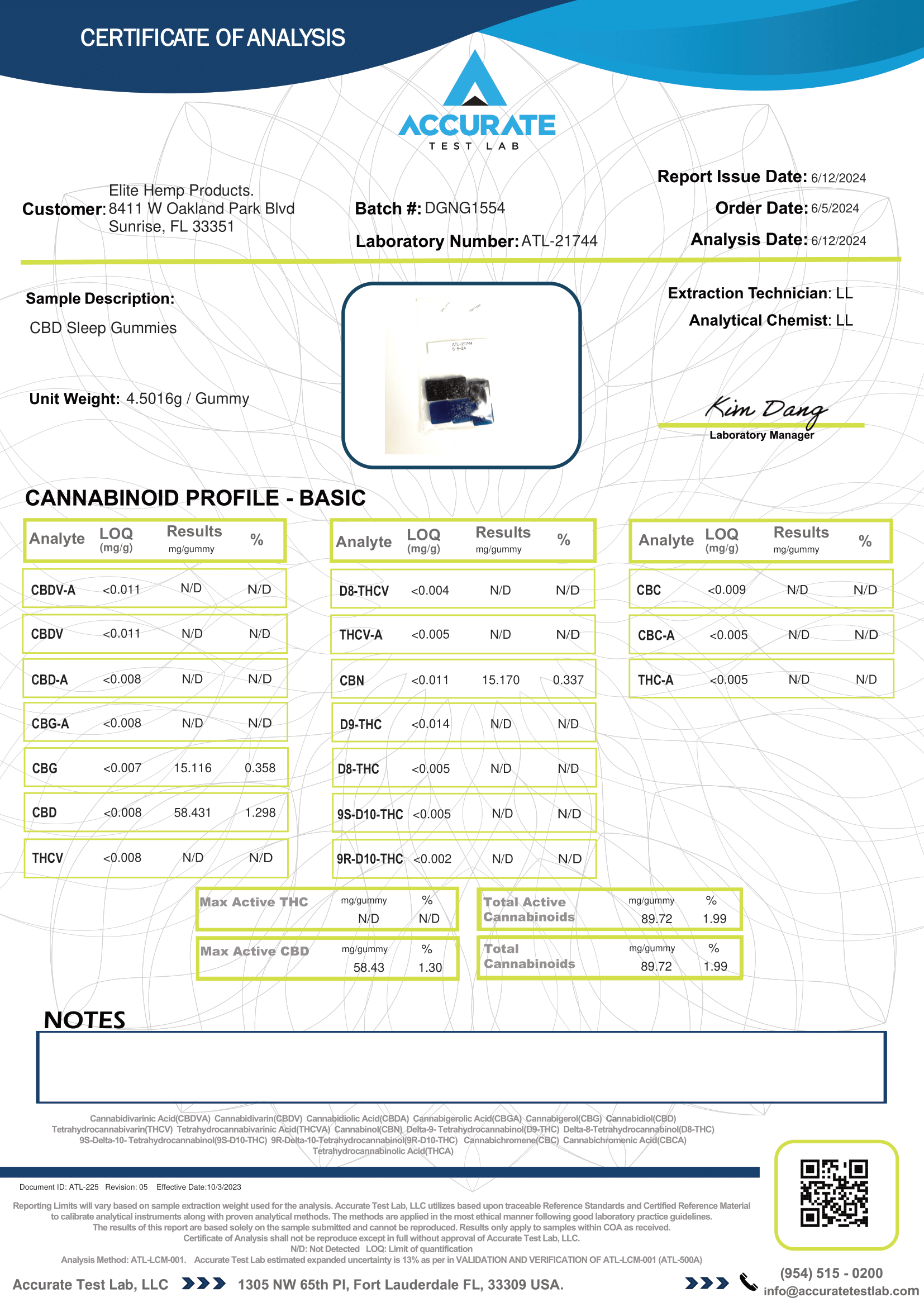
Look for the product name and a batch or lot number, and check it matches what’s printed on your package. A COA for a different batch tells you very little. Also check the test date — an old report on a current product is a yellow flag.
2. The cannabinoid profile
This is the main table. It lists each cannabinoid detected and how much is present, usually in mg/g or mg per unit. The important question: does the CBD content roughly match the label? If the bottle says 1000mg and the report shows substantially less, you’re not getting what you paid for.
You may also see CBG, CBN, CBC and others — normal in full-spectrum products.
3. The THC result
For hemp products, delta-9 THC should read 0.3% or less. If you want to avoid THC entirely, look for “ND” or “non-detect.” This is the number that matters most if you’re subject to drug testing — see does CBD show up on a drug test?
4. Contaminant panels
Good COAs go beyond cannabinoids and screen for what shouldn’t be there:
- Heavy metals — hemp readily absorbs metals from soil, so this matters.
- Pesticides
- Residual solvents — left over from extraction.
- Microbials — mold, yeast, bacteria.
Each should show a PASS result. A COA that only tests cannabinoids and skips contaminants is only telling you half the story.
5. Who issued it
The lab’s name and contact details should be on the report. Accreditation (often ISO 17025) is a good sign.
Red flags
- No COA at all, or “available on request” that never arrives.
- No batch number tying the report to actual product.
- Cannabinoid-only testing with no contaminant panels.
- A years-old report covering current inventory.
- An image of a report rather than the lab’s own document.
- Numbers that don’t match the label.
Why this is worth two minutes of your time
CBD is not tightly regulated for label accuracy, and independent studies have repeatedly found products that contain significantly more or less CBD than claimed — and sometimes THC that shouldn’t be there at all. Reading the COA is how you move from trusting a brand’s marketing to verifying it yourself.
It’s also a fair way to judge a company: brands that publish complete, current, third-party reports for every product are telling you something about how they operate.
See what full transparency looks like — browse Elite CBD’s lab reports, or shop lab-tested CBD.
These statements have not been evaluated by the Food and Drug Administration. Our products are not intended to diagnose, treat, cure, or prevent any disease. This article is educational only and is not medical advice.